
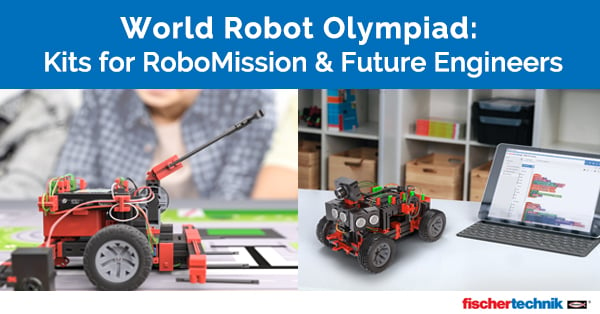
Quick Summary: The World Robot Olympiad™ (WRO) challenges students worldwide to design, build, and program autonomous robots that solve real-world problems. To support educators and competition teams, fischertechnik developed two purpose-built robotics kits: STEM Coding RoboMission for challenge-based field tasks and STEM Coding Competition for autonomous driving in the Future Engineers category.
World Robot Olympiad and the
Role of Robotics in Education
 The World Robot Olympiad™ (WRO) is a global, non-profit organization that organizes robotics competitions in over 95 countries. Students aged 8 to 19 participate in most categories, while the Future Engineers category allows participants up to age 22. WRO’s mission is to help young people develop creativity and problem-solving skills in a fun and engaging way while learning STEM (science, technology, engineering, and mathematics) and social skills.
WRO competitions focus on autonomous robotics. Students build robots that can sense their environment, navigate a field, and perform tasks independently. Teams are free to choose their own hardware and software within the rules, so educators should carefully consider which robotics kits and learning platforms best support their students’ development in programming, sensors, and autonomous behavior.
Understanding the WRO Competition Categories
The World Robot Olympiad is organized into four main competition categories, two of which are especially relevant for schools developing robotics programs: RoboMission and Future Engineers.
 RoboMission challenges students to design and program an autonomous robot to complete a series of tasks on a defined field. The field layout can change from round to round, so robots must respond to sensor input rather than follow memorized paths. Robots use color sensors, line-following sensors, and logic programming to navigate and complete challenges. This category emphasizes the fundamentals of autonomous robotics and algorithmic thinking.
 Future Engineers is designed for older students and focuses on building an autonomous vehicle that navigates a track efficiently and reliably. Teams must consider steering geometry, mechanical stability, sensor placement, and optimization to complete the course successfully. This category reflects current research trends in autonomous robotics and engineering workflows, aligning with the WRO Future Engineers competition rules.
STEM Coding RoboMission:
A Foundation for Autonomous Robotics
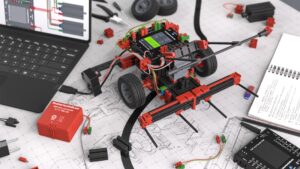 The STEM Coding RoboMission kit was developed specifically for the RoboMission category of the World Robot Olympiad. It provides students with the components and programming tools needed to build autonomous robots capable of navigating challenge fields. The kit is suitable for both classroom use and extracurricular teams.
Students work with the high-performance TXT 4.0 controller and a range of sensors, including color sensors and line-following sensors, which enable robots to detect colors, follow lines, and respond to the environment. Programming can begin with block-based visual coding in the ROBO Pro Coding App and can be extended to text-based Python or C/C++ coding for more advanced control.
The kit includes encoder motors, servo motors, and adjustable gears to support precise movement, as well as video tutorials that guide students through building and programming exercises. By using these components and programming tools, students can develop skills in sensor-based navigation, precise motor control, and autonomous task execution, all aligned with RoboMission competition requirements.
STEM Coding Competition:
Engineering for Future Engineers
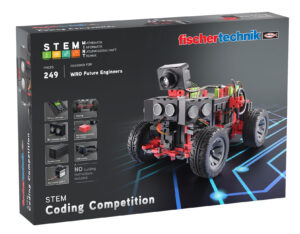 The STEM Coding Competition kit was developed specifically for the Future Engineers category of the World Robot Olympiad. It provides students with the components and tools needed to build an autonomous vehicle that can navigate a track according to WRO rules.
Students use the TXT 4.0 controller, encoder motors, ultrasonic sensors, a USB camera, and Ackermann steering with a servo motor to design a robot that can detect obstacles, follow the course, and drive autonomously. Programming is done through the ROBO Pro Coding App, which supports both graphical block-based coding and Python text coding, allowing students to control sensors, motors, and the camera for autonomous navigation.
The kit is intended for advanced learners and robotics teams who can work independently to design, build, and program their robot. The focus is on creating a functional autonomous vehicle in line with WRO competition requirements. Students develop skills in robot construction, sensor integration, programming, and autonomous control, all within the context of the Future Engineers category.
From RoboMission to Future Engineers:
A Learning Pathway
For schools using fischertechnik kits, students can progress from RoboMission to Future Engineers as their skills develop. Students may start with RoboMission, where they learn to work with sensors, motors, and programming to complete field-based challenges. As they gain experience, they can move to Future Engineers, where they design and program autonomous vehicles with more complex systems, including steering, drivetrain, and sensor integration.
These two fischertechnik kits support a multi-year robotics program for different age and skill levels:
| Grade / Skill Level | Recommended Kit | Focus Areas |
|---|---|---|
| Beginner (8–12) | STEM Coding RoboMission | Sensors, block-based programming, line following |
| Intermediate (12–15) | STEM Coding RoboMission (Block + Python) | Algorithms, precision control, optimization |
| Advanced (14–22) | STEM Coding Competition | Autonomous driving, steering mechanics, sensors, Python/C++ |
This pathway helps students develop skills needed for WRO competitions, including autonomous navigation, robot construction, and programming, while providing a structured progression from basic to advanced robotics tasks.
Frequently Asked Questions
What is the World Robot Olympiad?
The World Robot Olympiad is an international robotics competition that encourages students to learn STEM skills by building and programming autonomous robots.
Which fischertechnik kit is best for WRO beginners?
The STEM Coding RoboMission kit is ideal for students entering the RoboMission category, which includes the Elementary and Junior levels.
Which kit is suitable for RoboMission?
STEM Coding RoboMission was specifically designed to support the RoboMission category and related beginner programs.
Which kit supports Future Engineers?
STEM Coding Competition is designed for the Future Engineers category and focuses on autonomous driving and advanced engineering concepts.
Do these kits support Python programming?
Yes. Both kits can be programmed using Python through the ROBO Pro Coding environment, alongside visual programming options.
Can educators use these kits in the classroom outside of competitions?
Absolutely. Their robust sensors, controllers, and tutorials make them excellent for STEM, coding, engineering, and AI instruction.
Do the kits come with curriculum materials?
The RoboMission kit includes extensive didactic and tutorial resources. The Competition kit is more open-ended and intended for advanced learners and teams.
Conclusion
The World Robot Olympiad gives students the chance to build and program autonomous robots in a practical and hands-on way. Using the STEM Coding Competition and STEM Coding RoboMission kits from fischertechnik Education that align with WRO categories, educators can support students in learning STEM skills, programming, sensor integration, and autonomous control. Whether working with RoboMission or Future Engineers, students gain experience in building, coding, and testing robots while participating in team-based challenges that reflect the competition’s objectives.
Share this Post