Supporting Education Through Discovery-Based Learning
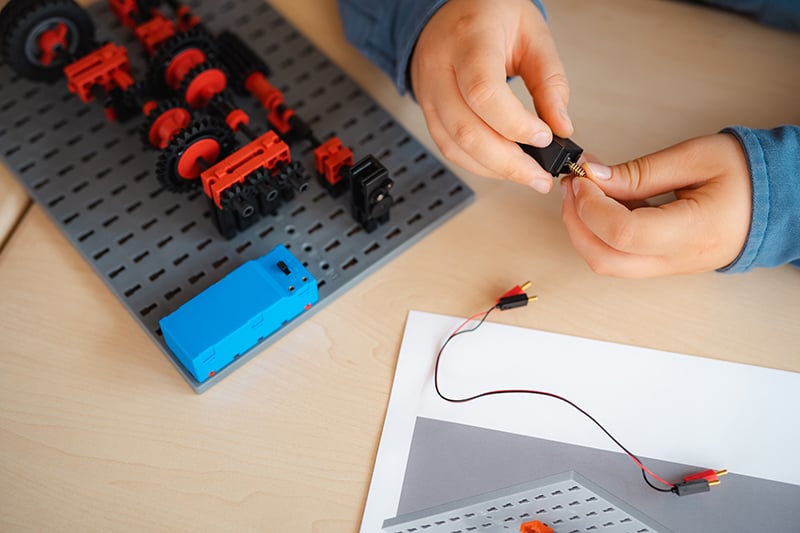
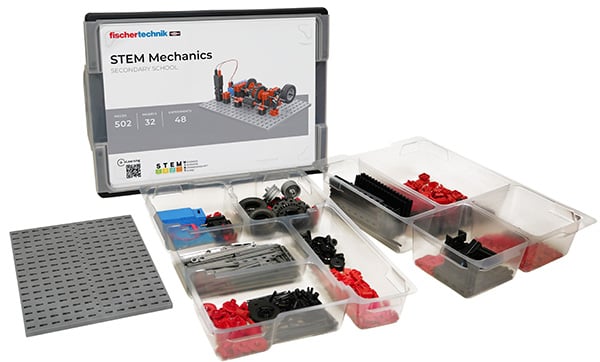 STEM Mechanics is designed to support both guided classroom instruction and independent exploration. Active learning plays an important role in helping students connect theoretical concepts to real-world applications, and this kit encourages that process through model-building and experimentation.
With more than 30 instructional models and over 500 components, students are able to design, build, and test mechanical systems while developing key future-ready skills such as problem-solving, critical thinking, creativity, teamwork, and measurement and analysis skills.
Flexible for STEM, Physics, and Engineering Classrooms
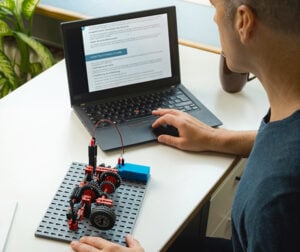 As students work through these activities, they gain a deeper understanding of how mechanics, motion, and structural principles apply to real engineering systems and everyday technologies.
This approach makes complex STEM concepts more approachable and engaging by allowing students to see and test how forces, motion, stability, and mechanical advantage work in real time. It also helps connect classroom concepts to practical engineering applications across a wide range of STEM topics, including levers, pulleys, gears, and structural systems.
The included online teaching resources provide additional support for educators with lesson materials, exercises, and instructional guidance that can be integrated into STEM curriculum planning for both structured lessons and independent learning environments.
Explore Core Concepts in Mechanics and Statics
The STEM Mechanics kit introduces students to a wide range of engineering and physics concepts through practical experimentation and model-building activities. As students construct and test working systems, they explore mechanical principles such as simple machines, gear ratios, and transmission systems while gaining a deeper understanding of how motion and force interact within engineering structures.
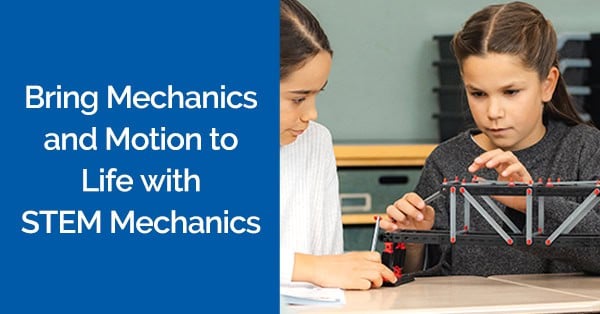
Students also investigate topics related to tensile and compressive forces, balance of forces, bridge construction, and structural stability. By building and observing these systems in action, learners can better visualize how mechanical components work together in real-world applications and technologies.
Connecting Theory to Real-World Engineering Applications
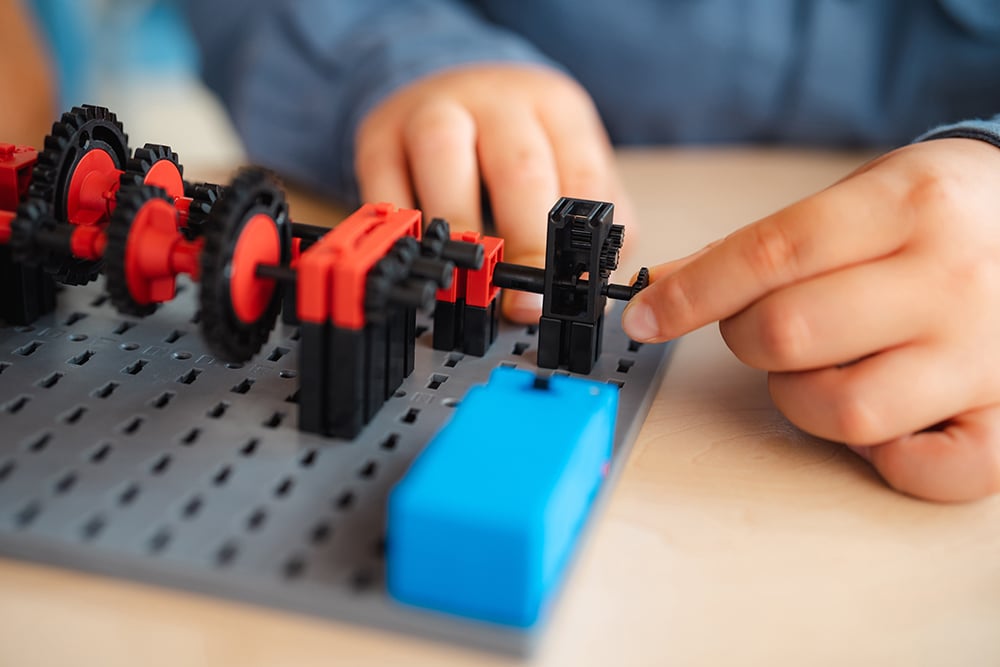 As students apply engineering concepts through model building, they begin to see how theory translates into real-world mechanical systems.
STEM Mechanics is designed to support a wide range of STEM learning environments, including physics, engineering, and technology-focused classrooms. The variety of models and activities allows educators to adapt lessons to different skill levels, curriculum goals, and instructional approaches, from guided demonstrations to open-ended investigation.
Because students actively build and test mechanical systems, the kit reinforces concepts in mechanics, motion, and structural design through direct experimentation. This flexibility makes STEM Mechanics a strong fit for inquiry-based and project-based STEM learning, where experimentation and problem-solving are central to the learning process.
Key Features of the STEM Mechanics Set
The table below outlines the key features of the STEM Mechanics set and their impact on learning.
| Learning Area |
Models & Key Concepts |
|
Mechanics, Forces & Motion
|
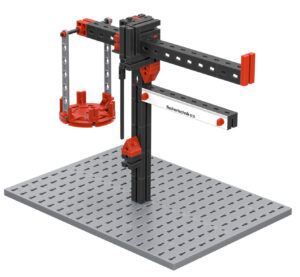
☑️ Beam Balance (Lever):
balance and force distribution
☑️ Double-Sided Lever:
mechanical advantage and equilibrium
☑️ Inclined Plane with Force Gauge:
force reduction and efficiency
☑️ Centrifugal Force Model:
rotational motion and force effects
☑️ Eccentric Press:
motion conversion and force application
☑️ Toggle Press:
force amplification through linkages
|
|
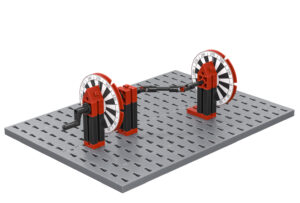
Gear Systems & Power Transmission
|
☑️ Cardan Shaft:
motion transfer through universal joints
☑️ Manual Transmission:
gear shifting and torque/speed relationships
☑️ Planetary Gear:
compact gear systems and torque distribution
☑️ Differential Gear:
wheel speed variation in turning systems
|
|
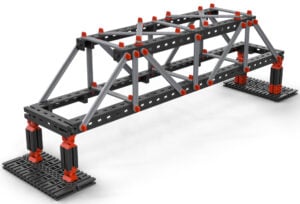
Structures & Statics
|
☑️ Table Structure:
load distribution and stability
☑️ Tower Structure:
vertical stability and structural integrity
☑️ Half-Timbering:
reinforcement and frame design
☑️ Half-Timbered House:
applied structural engineering
☑️ Beam Bridge:
load-bearing and stress distribution
|
|
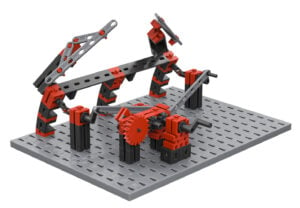
Real-World Mechanisms
|
☑️ Pulley Block:
force reduction systems
☑️ Crank-Push Scissors:
motion conversion mechanisms
☑️ Windshield Wiper (Concurrent):
synchronized motion systems
☑️ Windshield Wiper (Counter-Rotating):
opposing motion comparison
☑️ Parallel Windshield Wiper:
coordinated motion control
|
Frequently Asked Questions
What is the STEM Mechanics kit?
STEM Mechanics is a STEM education kit from fischertechnik Education designed to teach mechanics, statics, and physics through model-based experimentation and learning.
What grade levels is the STEM Mechanics kit suitable for?
STEM Mechanics is designed primarily for high school STEM education and is also suitable for upper middle school and secondary classrooms. It can be adapted for different skill levels, from structured instruction to open-ended engineering exploration.
What concepts can students learn with STEM Mechanics?
Students can explore core engineering concepts including gears, pulleys, levers, force equilibrium, motion transfer, bridge structures, and mechanical systems.
How many models can students build?
The kit includes components and instructions for building more than 30 instructional models.
Does STEM Mechanics include teaching resources?
Yes. The kit includes access to online teaching materials, exercises, and instructional support for classroom use.
What skills does STEM Mechanics help develop?
Students develop STEM knowledge along with problem-solving, teamwork, creativity, measurement, and analytical skills.
How does STEM Mechanics support STEM learning in the classroom?
STEM Mechanics supports STEM learning by allowing students to build and test mechanical systems while exploring forces, motion, and structural principles. This helps connect classroom concepts to real-world engineering applications.
Summary
The STEM Mechanics kit from fischertechnik Education helps transform engineering and physics concepts into engaging hands-on learning experiences. Through building activities and real-world mechanical applications, students gain a deeper understanding of mechanics, statics, motion, and structural design while developing important STEM and problem-solving skills.
With over 30 models, comprehensive teaching resources, and practical engineering applications, STEM Mechanics provides educators with an effective way to bring STEM learning to life in the classroom.

 ☑️ How does a planetary gear work?