
Quick Summary: Planetary gear motors combine a motor with a compact, high-torque gearbox, making them ideal for FTC mechanisms that need strength, precision, and reliability. In this article, we explain how they work, where to use them, and how to choose the right gear ratio for your robot’s drivetrain, lift, or intake using the FTC Legal Studica Robotics Maverick DC Planetary Gear Motors.
What Is a Planetary Gear Motor?
A planetary gear motor is a special type of motor combined with a planetary gearbox.
Planetary Gearbox vs. Planetary Gear Motor
A planetary gearbox is a mechanical system of gears, including the sun, planet, and ring gears. These gears work together to increase torque from the input shaft. On its own, the gearbox does not create motion; it simply modifies the output ratio of whatever motor’s input shaft it is connected to. When a motor, such as a DC motor, is integrated with this type of planetary gearbox, it becomes a planetary gear motor. This complete assembly converts electrical energy into smooth, high-torque mechanical motion by multiples of torque ratios. Some examples of common gearmotor ratios used in FTC Competitions are 1:1, 3.7:1, 13.7, 19.2:1, and 50.9:1.
A planetary gear motor’s gearbox has four main components has four main components:
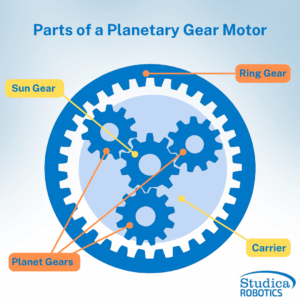 Sun Gear: The central gear connected to the motor’s output shaft.
- Planet Gears: Multiple gears that revolve around the sun gear, sharing the load.
- Ring Gear: The outer gear that encases the planet gears.
- Carrier: The component that holds the planet gears in place and connects them to the output shaft, allowing torque to be transmitted efficiently.
This arrangement allows the motor to deliver high torque in a compact package while maintaining efficiency and durability. Because the load is spread across multiple gears, planetary gear motors are precise, reliable, and able to handle heavy or repetitive tasks without wearing down quickly.
How Does a Planetary Gear Motor Work?
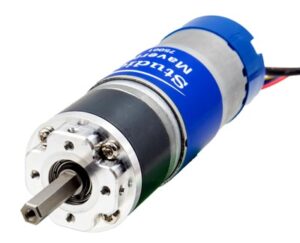 A planetary gearbox motor combines a motor with a planetary gearbox. The motor spins the sun gear, which causes the planet gears to rotate around it while also engaging the ring gear. This distributes the motor’s power across multiple gears, allowing the output shaft to deliver:
- Higher torque than the motor alone could provide.
- Controlled speed for the precise movement of mechanisms.
- Smooth motion with minimal backlash.
Why Use Planetary Gear Motors for FTC Robots?
Planetary gear motors are a powerful choice for FTC teams because they deliver high torque, precise control, and durability in a compact package, exactly what’s needed in competitive builds. Their efficiency minimizes voltage drop and keeps motion smooth across repeated matches, reducing wear on critical mechanisms.
For DECODE, where robots must manipulate and transport artifacts precisely while maintaining maneuverability, planetary gear motors help achieve consistent, strong, and responsive motion in subsystems like lifts, arms, and turrets.
Benefits of Planetary Gear Motors for FTC Robots
| Benefit | Why It Matters for FTC Robots |
|---|---|
| 🟦 High Torque Density | Provides strong lifting and pushing power in a small, lightweight form factor, ideal for compact designs. |
| 🟦 Low Backlash | Enables accurate, repeatable motion, critical for precise placement and autonomous scoring. |
| 🟦 Durability |
Distributes torque evenly across gears, resisting wear during repeated competition matches. 👉Tip: While these motors are sealed and don’t require regular lubrication, avoiding overload and excessive strain during matches helps keep them reliable over time. |
| 🟦 Efficiency | Reduces energy loss and voltage drop, maximizing battery life during long matches. |
| 🟦 Compact Design | Fits into tight builds, letting teams design efficient, space-saving mechanisms. |
| 🟦 Smooth, Quiet Operation | Reduces vibration for steadier motion control, useful in mechanisms like arms or claws. |
| 🟦 Versatility | Most planetary gearbox motors allow teams to optimize torque and speed for different mechanisms. |
FTC Robotics Applications for Planetary Gear Motors
Planetary gear motors are versatile components that can power a wide range of mechanisms in FTC robotics, including:
→ Drivetrains: Compact, high-torque planetary motors help drivebases accelerate smoothly and push reliably.
→ Intakes: Pull in and move game elements efficiently.
→ Turrets: Smooth, controlled rotation for aiming or rotating mechanisms.
→ Arms & Lifts: Provide precise, high-torque motion for moving game elements.
→ Claws & Grippers: Precise, repeatable control for picking up or holding objects.
Example FTC Applications
Here’s a quick reference table showing typical FTC applications for planetary gear motors, along with the recommended gear ratios and their benefits:
| Application | Recommended Gear Ratio | Benefit |
|---|---|---|
| Drivetrain | 19.2:1 | Balanced speed and torque for consistent driving power. |
| Lifts or Elevators | 50.9:1 | High torque for heavy lifting under load. |
| Arms or Turrets | 13.7:1 | Fast yet controlled motion for scoring and aiming. |
| Intake or Shooter Mechanisms | 3.7:1 or 1:1 | High-speed output for quick artifact collection or launch. |
How to Choose the Best Motor for Your FTC Robot
Planetary gear motors give FTC teams the balance of strength, precision, and efficiency needed for advanced designs. Choosing the right gear ratio and motor type can make a major difference in your robot’s performance throughout the competition season. Studica Robotics offers a DC motor and a variety of planetary gearbox DC motor options to choose from in 1:1, 3.7:1, 13.7, 19.2:1, and 50.9:1 gearbox ratio options with a 6mm Hex output shaft. Use this handy table to help make the best selection.
|
Motor Option |
Gear Ratio |
Output Speed (approx. RPM) |
Torque (approx. Nm) |
Best For |
Why Choose This Motor |
|
~240 |
~2.3 |
Simple low-load mechanisms (e.g., sensors, light-duty intakes, small arms) |
Basic spur design: cost-effective, good for learning and light use where precision torque isn’t critical. |
||
|
~6100 |
~0.39 |
High-speed shooters, intake rollers |
Extremely fast output: use external gearing (belts, pulleys, sprockets) to manage torque. Best where speed is more important than precision. |
||
|
~1650 |
~1.2 |
Fast-moving mechanisms like intake rollers or flywheels |
Trades torque for RPM, excellent for speed-based mechanisms needing consistent output. |
||
|
~445 |
~3.3 |
Lifts, linkages, or medium-load manipulators |
Balanced torque and speed. Ideal for arms and lifts needing both power and smooth control. |
||
|
~320 |
~2.4 |
Drivetrains, medium-duty arms, or dual-purpose lifts |
Strong balance between torque, speed, and precision. A great “general-purpose” choice for FTC teams. |
||
|
~120 |
~6.4 |
High-torque applications — heavy lifts, turrets, or arms |
Delivers maximum torque for demanding mechanisms. Ideal where precise, slow control is key. |
👉 Tips for Choosing Your Gear Ratio
→ Need Torque? Choose higher ratios (50.9:1 or 19.2:1).
→ Need Speed? Choose lower ratios (3.7:1 or 1:1).
→ Need Balance? 13.7:1 is the versatile middle ground for most FTC subsystems.
→ Need Simple Motion? Use the standard Spur Gear (61:1) for low-stress applications.
📌 FTC Note: The Studica Robotics Maverick 12V DC Gear Motor and all of our Maverick DC planetary gear motors are FTC Legal for the DECODE competition.
Frequently Asked Questions
Frequently asked questions about planetary gear motors in FTC robotics:
How do planetary gear motors improve FTC robots?
Planetary gear motors provide smooth, controlled motion under load by distributing torque evenly across multiple gears, helping FTC robots maintain consistent performance during competition.
What are the benefits of using planetary gear motors in your robot design?
They combine high torque density, precision, and durability. This makes them ideal for FTC mechanisms that require controlled motion and strength, such as arms, lifts, drivetrains, and turrets.
Are Studica Robotics planetary gear motors FTC Legal?
Yes. Studica Robotics offers FTC Legal planetary gear motors that comply with official rules.
What’s the difference between a planetary gear motor and a standard DC motor?
A planetary gear motor combines a DC motor with a planetary gearbox that provides smoother, more controlled motion and better load handling. A standard DC motor has no gearbox, so it spins freely at high speed but offers less precision and control for mechanisms that need accurate movement.
Can I mix planetary and spur gear motors on the same robot?
Yes. Many FTC teams use planetary gear motors for high-torque or precision tasks and spur motors for simpler or lightweight mechanisms. It’s a cost-effective way to balance performance and efficiency.
How do I choose the right gear ratio for my FTC robot?
Choose higher gear ratios (like 50.9:1 or 19.2:1) for torque-heavy systems such as lifts or arms, and lower ratios (like 3.7:1 or 1:1) for speed-focused systems like intakes or shooters. The 13.7:1 ratio offers a good balance for most mechanisms.
What’s the best gear ratio for drivetrains in FTC?
A 19.2:1 planetary motor is often ideal because it offers a great mix of torque and control for consistent driving and pushing power.
Do planetary gear motors require maintenance?
They’re sealed and typically maintenance-free, but avoid overloading them or exposing them to debris. Periodically check mounting screws and couplers to ensure they remain secure through competition.
Can I swap gearboxes between different Maverick motors?
Yes, you can swap the gearboxes as long as that gearbox shares the same pinion.
Choosing Power and Precision for FTC Success
Using a planetary gearbox DC motor provides FTC teams with the torque, control, and reliability needed to compete at a high level. Whether your robot needs smooth motion for arms and lifts or strong drive power for pushing and maneuvering, choosing the right gear ratio can make all the difference.
Studica Robotics’ FTC Legal Maverick Planetary DC Gear Motors offer proven performance and durability, making them a smart choice for any DECODE season build.
Share this Post