
Quick Summary: Robot wheels play a crucial role in your FTC DECODE robot’s performance. From gripping and guiding artifacts to powering your drivetrain or shooter, the right wheel type can make or break consistency. Flex wheels, also known as compliant wheels, are designed to deform slightly for better grip, making them ideal for intakes, conveyors, and ball-handling systems. Drive wheels, on the other hand, focus on traction and power transfer, helping your robot move and launch with control. Studica Robotics offers a full range of robot wheels in multiple sizes and durometer ratings, allowing teams to optimize every system, from pickup to propulsion, for reliable results this 2025–2026 FIRST Tech Challenge DECODE season.
Why Wheels Matter for FTC DECODE
Every FTC team knows the frustration: your intake grabs some game pieces easily, but others slip away. Or your conveyor jams at the worst moment. Or your shooter sends pieces flying, inconsistently.
 That’s where robot wheels come in. Flex wheels are soft, compressible wheels made from durable polyurethane or silicone rubber, designed for robotics applications requiring high traction and flexibility. Their compliant material allows the wheel surface to deform and grip, conforming to irregular shapes and uneven surfaces. Drive wheels are wheels that receive power from a motor that transforms torque into a tractive force for movement.
You’ll see wheels used in intakes, conveyors, shooters, and rollers because their flexibility helps them:
- Wrap around game pieces → better pickup.
- Maintain traction during transfers → fewer jams.
- Transfer energy efficiently → consistent launches.
Selecting the correct durometer rating (or hardness level) can have a big impact on your robot’s overall performance. This rating measures material stiffness and indicates how soft, sticky, or slippery the wheel feels. We’ll explore how to choose the right hardness for your robot later in this article.
Using the right wheel type in the right place can completely change how your robot performs. Flex wheels give you control and precision when handling objects. Drive wheels give you power and stability when moving or launching them. Many FTC teams are finding success by using both this DECODE season.
Robot Wheel Applications for the DECODE Season
In the 2025–2026 FIRST Tech Challenge DECODE season, how your robot handles artifacts can make a big difference in matches. Robot wheels are a simple but powerful way to improve grip, speed, and control across your intake, indexing, and shooting systems. Choosing the right wheel hardness and size ensures smoother performance from pickup to launch.
Here’s how different wheel setups can improve each subsystem in your FTC DECODE robot.
| Application | Purpose | Best Flex Wheel Hardness | Recommended Sizes | Tips & Examples |
|---|---|---|---|---|
|
Intake Systems |
Pulls artifacts into the robot reliably, even when they’re not perfectly aligned. |
|
100mm | Softer flex wheels increase grip for consistent pickup. Some teams even cut 50mm wheels into star shapes for more aggressive artifact collection. |
|
Indexers & Conveyors |
Moves artifacts inside the robot with speed and control. |
|
50–100mm | The 2025–2026 FTC Starter Bot by Studica Robotics uses drive wheels in its conveyor for consistent feeding and reliable handoffs. |
|
Shooting & Outtake Mechanisms |
Launches or releases artifacts with accuracy and power. |
|
50mm | The Studica Robotics FTC Starter Bot’s flywheel shooter uses a combination of flex and drive wheels to deliver controlled, powerful shots. |
FTC DECODE Robot Wheels Application Examples:
Below are real-world examples of how wheels are used on the Studica Robotics FTC Starter Bot (2025–2026 DECODE™ season).
| Intake System: Flex wheels help grab and guide game pieces into the robot efficiently. |
Indexer: Flexible drive wheels guide and move pieces along the conveyor while maintaining grip to prevent jams. |
Shooter Mechanisms: A combination of flex and drive wheels provides consistent energy transfer for accurate and reliable launches. |
 |
 |
 |
Choosing the Right Wheel Hardness
Selecting the correct durometer rating (or hardness level) can have a big impact on your robot’s overall performance. Softer wheels grip better and absorb irregularities, making them ideal for picking up and moving game pieces. Harder wheels, on the other hand, transfer more energy, making them perfect for shooting or launching artifacts with speed and consistency.
Use the chart below to find the best flex characteristics for your FTC DECODE robot build.
| Durometer Rating | Flexibility | Grip | Energy Transfer | Best For |
|---|---|---|---|---|
| 35A | Very soft | High | Low | Intakes, conveyors |
| 40A | Soft | High | Moderate | Intakes, transfer rollers |
| 50A | Medium | Moderate | High | Shooters, accelerators |
| 60A | Firm | Low | Very High | Long-range shooters |
👉 Helpful Tips:
- Start with softer wheels for intakes.
- Use harder wheels for shooters.
- Always prototype with multiple hardness values, as every design is unique.
Modifying Flex Wheels for DECODE
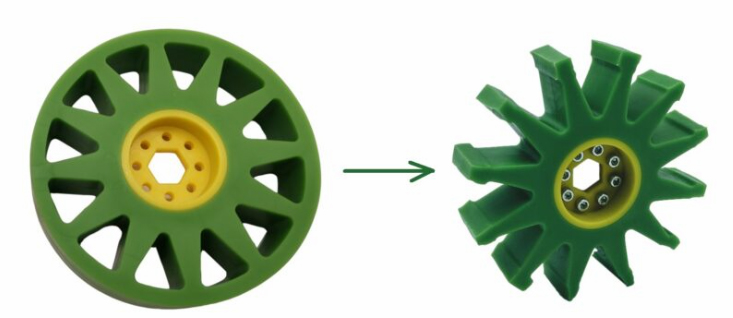
Compliant wheels aren’t meant to move your robot; they’re designed to move artifacts efficiently. Many teams also modify wheels to improve ball handling. For instance, trimming the edges of smaller wheels to create a star-shaped design can help the wheel flex slightly more, improving pickup and transfer when balls aren’t perfectly aligned or when handling multiple balls quickly.
👉 Tip: This modification is optional but can improve intake performance, especially during rapid ball handling in matches.
What Makes Studica Robotics Wheels Stand Out?
Not all wheels are created equal.
- Studica Robotics’ TPU polyurethane design balances durability, flexibility, and grip, ideal for FTC.
- Other brands may use silicone rubber or alternate TPU blends. These can perform differently in terms of wear, stickiness, and stiffness.
👉 Studica Robotics wheels are engineered with FTC robots in mind, giving teams reliable options sized for common intake, conveyor, and shooter designs.
Studica Robotics Robot Wheels Options
Not all flex wheels feel the same! With Studica Robotics’ TPU-based assortment, available in multiple sizes and hardness levels, you can fine-tune your intake, conveyor, and shooter systems for competition-ready performance. Check out the chart below to match the best wheel to your robot’s intake, conveyor, or shooter setup.
100mm Flex Wheels — Ideal for Ground Intakes
| Size | Hardness (Durometer Rating) |
Part # | Image | Type | Best Use Cases |
|---|---|---|---|---|---|
| 100mm |
35A |
#76263 |  |
Softer | Ground intakes, sweeper rollers, transfer rollers |
| 100mm | 40A | #76264 |  |
Softer | Ground intakes, sweeper rollers, transfer rollers |
| 100mm | 50A | #76265 | 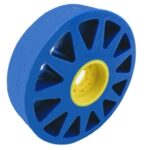 |
Harder | Ground intakes, sweeper rollers, transfer rollers |
| 100mm | 60A | #76266 | 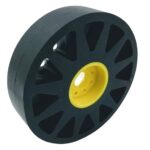 |
Harder | Ground intakes, sweeper rollers, transfer rollers |
50mm Drive Wheels — Ideal for Conveyors & Shooters
| Size | Hardness (Durometer Rating) |
Part # | Image | Type | Best Use Cases |
|---|---|---|---|---|---|
| 50mm | 35A | #76267 | 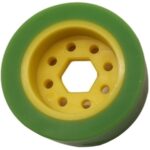 |
Softer | Conveyors, indexers, shooters, compact mechanisms |
| 50mm | 40A | #76268 | 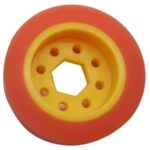 |
Softer | Conveyors, indexers, shooters, compact mechanisms |
| 50mm | 50A | #76269 | 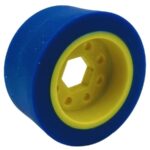 |
Harder | Conveyors, indexers, shooters, compact mechanisms |
| 50mm | 60A | #76270 | 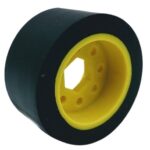 |
Harder | Conveyors, indexers, shooters, compact mechanisms |
Frequently Asked Questions
Are flex wheels and compliant wheels the same?
Yes. “Compliant wheels” is the older term, while “flex wheels” is more common in FTC. Both refer to soft, deformable wheels made for gripping and moving game pieces.
What’s the difference between flex wheels and drive wheels?
Flex wheels are designed to grip and control artifacts, while drive wheels are built to transfer power and move your robot or launch elements. Many FTC teams use both for balanced performance.
Which size wheels should my team use?
100mm wheels work best for ground intakes. 50mm wheels, flex or drive, are ideal for conveyors and shooters.
Can you customize or modify flex wheels?
Yes. Many teams cut smaller wheels into star shapes or modify them for unique mechanisms.
Do softer wheels wear out more quickly?
Softer hardness values (35A/40A) may wear more quickly under heavy use but provide superior grip and control.
Are Studica Robotics wheels FTC legal?
Yes. Studica’s flex and drive wheels comply with FTC part rules and are widely used by competition teams.
Should my team use them for DECODE?
Absolutely. Compliant-style wheels help ensure consistent pickup, reliable feeding, and controlled shooting of DECODE artifact balls.
Does the Studica Robotics FTC Starter Kit include wheels?
Yes! The FTC Starter Kit 2025-2026 Season (DECODE™) includes omni, flex, and drive wheels.
Can I mix different hardness wheels on the same robot?
Yes, many teams use softer wheels for intakes and conveyors and harder wheels for shooters. Experimenting with combinations can help balance grip and speed.
How do I know which hardness to start with?
Start with 35A–40A for intakes and conveyors, and 50A–60A for shooters. Prototype and adjust based on your robot’s design and the DECODE game elements.
Do I need special tools to install or modify flex wheels?
No special tools are required, but scissors, hobby knives, and calipers are helpful if you want to trim or modify wheels for unique designs.
Final Thoughts
In the DECODE season, every second counts, and your robot’s wheels can be the difference between a smooth cycle and a stalled run. Whether you’re using flex wheels for precise control of artifacts or drive wheels for dependable traction and launch power, the right combination helps your robot perform at its best.
Studica Robotics offers a full line of flex and drive wheels designed specifically for FTC applications. With multiple sizes and durometer ratings available, you can fine-tune your intake, conveyor, drivetrain, and shooter systems for consistent, competition-ready performance.
Prototype, test, and iterate to achieve your robot’s best performance. You’ve got this!
FTC teams in the USA: Studica Robotics holds a monthly grant drawing (sign up now) and offers exclusive discounts to FIRST teams!
Share this Post