
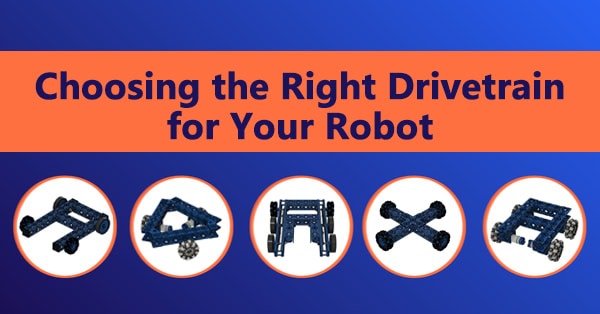
Quick Summary: Your robot’s drivetrain determines how it moves on the field, how easy it is to control, and how well it performs during matches. For FTC teams and other robotics programs, the most common options are tank drive, mecanum drive, and other holonomic systems like X-Drive or Kiwi (A-Frame). This article breaks down the advantages, disadvantages, programming complexity, and strategic uses of each drivetrain type so teams can make informed design choices.
Understanding Drivetrains
Your robot’s drivetrain is the foundation of how it moves and interacts with the game field. Choosing the right drivetrain affects not only performance but also how easy it is to build, program, and drive during a match.
 A well-designed drivetrain impacts:
-
Speed: How quickly your robot moves across the field.
-
Maneuverability: How easily it changes direction.
-
Traction: Grip on the game surface.
-
Mechanical complexity: Difficulty to build and maintain.
-
Driver control: Ease of operation during matches.
Tank Drive
Tank drive is one of the most common drivetrains for FTC robots, especially for beginner teams. Its straightforward design and simple control make it ideal for teams focusing on pushing power, defense, and reliability. While it doesn’t allow sideways movement (strafe), it’s durable, easy to build, and simple to program, making it beginner-friendly.
| Details | |
|---|---|
| Description | Wheels on the left and right sides move independently. Forward/backward is simple; turning requires spinning one side faster. |
| Advantages | High traction and pushing power; simple to build and maintain; beginner-friendly; durable and reliable. |
| Disadvantages | Cannot strafe sideways; slower alignment with targets; less efficient for fast, precision scoring. |
| Best Use Cases | Pushing/defense-focused strategies; beginner teams; games prioritizing stability over speed or complex maneuvers. |
| Programming Complexity | Low. Direct joystick-to-motor mapping; no vector math required. |
Before diving into wheel configurations, teams should consider how the number of powered wheels will affect traction, stability, and turning. Choosing the right setup can improve performance on the field without adding unnecessary complexity.
| Common Tank Drive Configurations: | Examples: | |
|---|---|---|
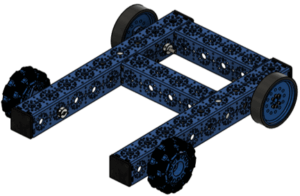
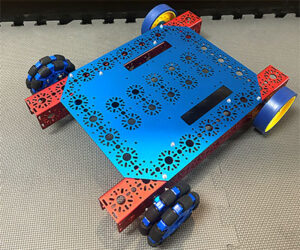
| 2WD Tank Drive
Prototype/learning platform, less traction |
 |
 |
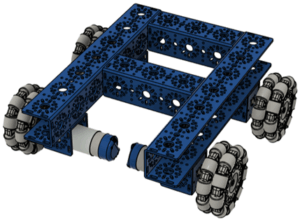
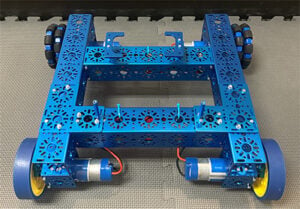
| 4WD Tank Drive
Balanced, most common in FTC |
 |
 |
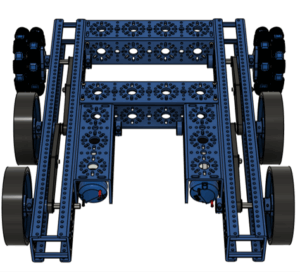
| 6WD Tank Drive
Better traction and weight distribution, slightly more complex |
 |
 |
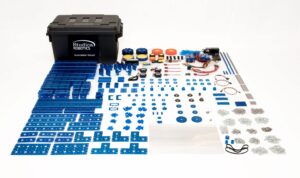 The FTC Starter Kit 2025–2026 from Studica Robotics gives teams everything they need to build a reliable tank drive robot. Made with precision 6061-T6 aluminum structure parts, it is durable, safe, and easy to assemble, making it ideal for beginner and intermediate teams focused on pushing power, reliability, and straightforward programming. The kit includes updated Maverick Motors with Hex Shafts, optional planetary gearboxes, and 6mm Hex components, and comes in six vibrant structure colors. FTC teams are eligible for discounts.
Mecanum Drivetrain
Mecanum drivetrains use four specialized wheels with angled rollers, allowing your robot to move in any direction without rotating first. This makes them highly maneuverable and ideal for scoring-focused or precision-based games. While they offer excellent alignment and cycle efficiency, they require more careful setup and programming than a tank drive.
| Details | |
|---|---|
| Description | Uses four mecanum wheels with angled rollers for omnidirectional movement. Can move forward, backward, sideways, diagonally, and rotate in place. |
| Advantages | High maneuverability; can strafe without rotating; fast alignment with scoring targets; excellent for cycle-based scoring games. |
| Disadvantages | Lower traction and pushing power than tank drives; sensitive to weight distribution; moderate-to-high programming complexity (vector math required). |
| Best Use Cases | Scoring-focused or precision-based games; intermediate to advanced teams. |
| Programming Complexity | Moderate to high; requires vector math for combining forward, strafe, and rotation inputs; motor mixing needed for smooth movement. |
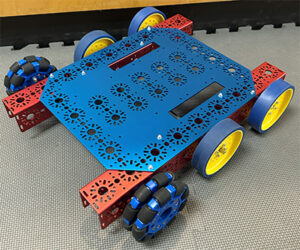
Mecanum Drivebase Examples
 |
|
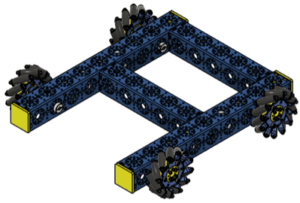
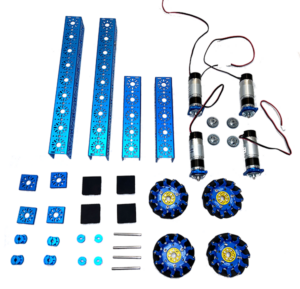
✅ The FTC Drive Base Kit from Studica Robotics is a competition-ready Mecanum drivetrain designed specifically for FTC teams.
✅ Built with reliable, precision components, the FTC Drive Base Kit supports advanced autonomous paths and demanding maneuvers.
✅ The kit is available in a variety of structure colors including blue, red, black, green, silver, and gold, with D-shaft or Hex-shaft components.
Other Holonomic Options
Beyond Mecanum, there are other holonomic drivetrains that allow omnidirectional movement, meaning the robot can move in any direction without needing to rotate. X-Drive and Kiwi (A-Frame) designs are less common in FTC but offer unique advantages in maneuverability and compact design. They require more careful setup and programming than tank drives or Mecanum systems, so they’re generally used by intermediate or advanced teams.
X-Drive
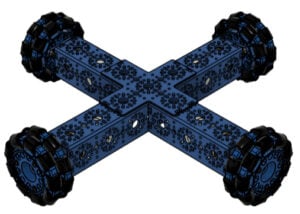
X-Drive is a holonomic drivetrain with four omni-wheels mounted at 45° angles. Like Mecanum, it allows true omnidirectional movement, but with straight rollers instead of angled rollers. This makes motion smooth and predictable, though traction is lower than a tank drive.
|
Details |
|
|---|---|
| Description | Four omni-wheels at 45° angles; moves in any direction without rotating first. |
| Advantages | True omnidirectional movement; smooth transitions; predictable motion. |
| Disadvantages | Lower traction; tricky to fit mechanically; may interfere with frame design. |
| Best Use Cases | Advanced maneuvering; games needing precise omnidirectional control. |
| Programming Complexity | Moderate to high; requires vector math and careful motor calibration. |
X-Drive Examples
 |
 |
Kiwi (A-Frame) Drive
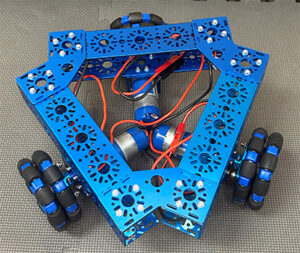
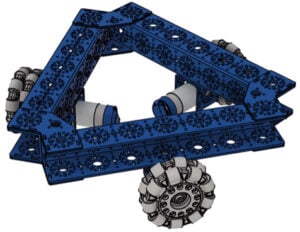
The Kiwi (or A-Frame) uses three omni-wheels arranged in a triangle. Each wheel contributes to all directions of movement, giving omnidirectional motion in a minimal footprint. This setup is lightweight and uses fewer motors, but stability can be an issue.
| Details | |
|---|---|
| Description | Three omni-wheels in a triangular configuration; omnidirectional movement with minimal components. |
| Advantages | Fewer components; lightweight; efficient motor usage; true omnidirectional motion. |
| Disadvantages | Less stable; sensitive to weight distribution; more complex programming; requires vector math. |
| Best Use Cases | Compact or motor-limited robots; teams wanting true omnidirectional control in a small footprint. |
| Programming Complexity | Moderate to high; requires vector math; less intuitive than tank or mecanum drives. |
Kiwi (A-Frame) Examples
 |
 |
Decision-Making Guidance
When choosing a drivetrain, teams need to balance gameplay priorities, robot complexity, and driver skill. No single drivetrain is best in every situation; what works for a pushing-heavy strategy might not be ideal for fast, precision scoring. This table provides a side-by-side comparison of tank and holonomic drivetrains across key performance priorities:
| Priority | Tank Drive | Holonomic (Mecanum/X/Kiwi) |
|---|---|---|
| Pushing / Defense | High traction, strong grip | Lower traction, easier to be pushed |
| Scoring / Precision | Slower repositioning | Faster alignment, smooth cycles |
| Speed vs. Control | Stable at higher speeds, simple | Flexible movement, higher control ceiling |
| Simplicity vs. Performance | Easier to build and program | More complex, higher performance potential |
Tips for FTC teams:
✅ If your robot will spend most of the match scoring and cycling, a holonomic drivetrain (mecanum/X/Kiwi) can save time and improve accuracy. If your focus is defense or straightforward, reliable play, a tank drive keeps things simple and robust.
✅ Consider your team’s experience level, game strategy, and mechanical skill when selecting a drivetrain.
✅ Use simpler tank drives for early competitions or defensive strategies.
✅ Invest in mecanum or X-Drive if your game emphasizes precision scoring or requires frequent lateral movement.
Frequently Asked Questions
Which drivetrain is easiest for beginners?
The tank drive is the simplest to build, program, and operate.
Can Mecanum drives push as well as tank drives?
No, they have less traction and lower pushing power, so they are better for scoring and maneuvering.
Are X-Drive or Kiwi drives common in FTC?
They are less common and are usually chosen for compact robots or specialized strategies.
How do I decide between 2WD, 4WD, or 6WD tank configurations?
2WD for prototypes/learning, 4WD for balanced performance (most FTC teams), 6WD for heavy or defensive robots.
What is a holonomic drivetrain?
A holonomic drivetrain lets a robot move in any direction without rotating first. Examples include mecanum, X-Drive, and Kiwi drivetrains.
Are there robotics kits available to create a mecanum drivetrain?
Yes, FTC teams can use the FTC Drive Base Kit from Studica Robotics to build a mecanum drivetrain.
Conclusion
Choosing the right drivetrain is critical for aligning your robot’s design with your team’s strategy, skill level, and competition goals. Tank drives excel in defense and simplicity, while mecanum and other holonomic drives offer superior maneuverability and precision scoring potential.
For FTC teams, solutions like the FTC Starter Kit 2025–2026 and the FTC Drive Base Kit from Studica Robotics provide practical, high-quality options for building reliable tank or mecanum drivetrains, helping teams get up and running with proven components.
Share this Post