
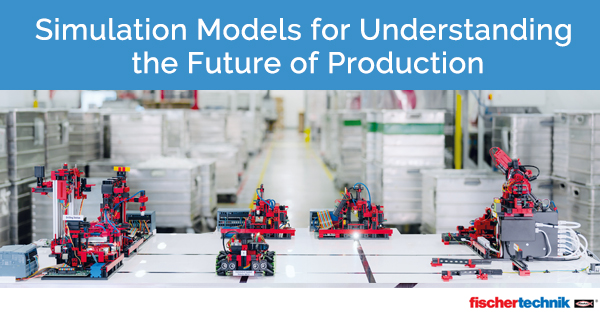
Quick Summary: As production systems become more agile, AI-driven, and digitally connected, higher education and industry institutions need effective simulation models to bridge theory and hands-on application. This article explores the fischertechnik Agile Production Simulation and Training Factory 4.0, showing how each solution helps educators and professionals teach, engage in hands-on learning, and conduct applied research in automation, PLC (Programmable Logic Controller) programming, digital twins, IoT integration, and advanced manufacturing processes.
Why Simulation Models Matter
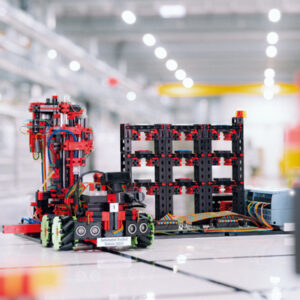 Full-scale industrial production systems are costly and complex, yet students and professionals need hands-on experience with automation, PLC programming, IoT, digital twins, and production workflows to gain real expertise.
fischertechnik addresses this challenge with a simple philosophy: understand complex systems on a small scale before scaling up. Its compact, modular simulation models provide a safe and scalable environment where learners can explore real industrial processes. These systems are fully operational, allowing users to engage with automation control, AI-supported quality management, networked production, and automated guided vehicles without the cost and risk of a full industrial facility.
As Dr. Carlos Teixeira from RMIT University explains, “fischertechnik systems are compact, affordable, and provide students the ability to apply advanced theoretical knowledge to solve complex real-world problems.”
Case Study: Neural Production Networks in Research
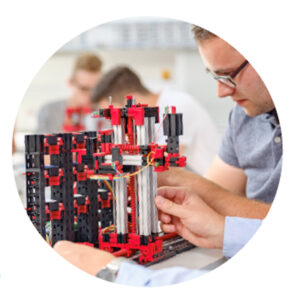 Researchers at the University of Potsdam used the Training Factory 4.0 as part of a globally distributed neural production network to investigate how artificial intelligence could be applied in production control. In this study, jam production was simulated across four international sites with varying IT infrastructures. The Training Factory served as one of the networked haptic production stations, modeling the full process from raw material storage to processing and distribution.
By integrating artificial neural networks into their control logic, the researchers were able to identify inefficiencies in knowledge flows and optimize coordination strategies across the global production network, achieving measurable improvements in distributed Industry 4.0 operations. As Prof. Dr. Grum noted, “With the fischertechnik Training Factory 4.0, we can expand previous research into the control of artificial knowledge transfer as a coordination tool,” highlighting the system’s value as a flexible platform for advanced research experiments conducted externally. Read the full case study.
Bridging Theory and Practice
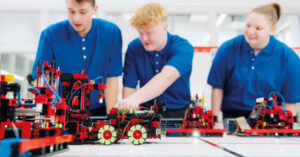
As production systems evolve toward agility, AI, and digital connectivity, institutions face a critical question: how can intelligent production systems be taught, tested, and researched without installing a full-scale industrial facility? Modern manufacturing demands skills in AI-driven process control, PLC programming, IoT-enabled communication, digital twins, agile production strategies, and cloud-connected monitoring.
Advanced simulation models like the Agile Production Simulation (APS) and Training Factory 4.0 provide practical solutions for hands-on learning and applied research for higher education and industry training. These models replicate real manufacturing logic in a compact and flexible format, allowing students and professionals to apply theoretical knowledge in a practical, hands-on setting.
Agile Production Simulation
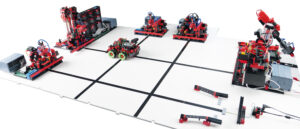 The Agile Production Simulation (APS) is a miniature, modular factory that combines workshop flexibility with assembly-line efficiency. It enables learners to explore small-batch production, product customization, and rapid adaptation to changing demands. Add-ons such as automated guided vehicles enable the simulation of parallel workflows, task prioritization, and new production derivatives. The integration with a Digital Learning Platform provides interactive dashboards, cloud interfaces, and digital twins. APS is well suited for teaching agile production strategies, AI-supported quality control, and Industry 4.0 concepts, giving students hands-on learning opportunities and practical training with future-ready manufacturing systems.
Training Factory Industry 4.0
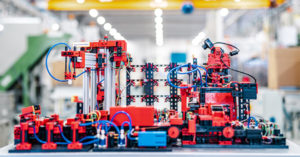 The Training Factory Industry 4.0 models a fully networked, industrial-grade production environment, creating a networked smart factory that features IoT traceability, cloud monitoring, PLC (Programmable Logic Controller) automation, distributed coordination, and PLC-controlled process automation compatible with external research and control systems. It features multi-processing stations, sorting lines, a high-bay warehouse, and a 3-axis robot, with open-source programming, Raspberry Pi gateways, Node-RED communication, dashboards, and cloud connectivity. This hands-on system turns Industry 4.0 from a concept into a practical learning environment, allowing learners to study automation, IoT, and production processes realistically.
The Training Factory is available in two control types:
-
9V Version – Uses multiple fischertechnik TXT 4.0 controllers with Python-based programming, offering accessibility and flexibility for mechatronics programs, advanced STEM environments transitioning to industrial automation, and Industry 4.0 introduction courses.
-
24V Version – Requires an external industrial PLC and comes in three configuration levels:
-
Siemens S7-1500 24V – Plug-and-play solution for Siemens PLC environments, ideal for engineering faculties, industrial automation labs, and industry-aligned technical institutes.
-
PLC Connection Board 24V – Supports brand-independent PLCs, allowing institutions to use their preferred PLC while retaining structured programming and IoT gateway functionality.
-
24V Base Model – Includes the mechanical and electrical factory hardware, but the user must provide their own PLC, wiring, connection board, and integration. A sample Structured Text program is provided for Siemens S7-1500 PLCs and must be adapted if using other PLC platforms.
-
Agile Production Simulation vs. Training Factory 4.0
Although both systems support Industry 4.0 education, they serve different strategic objectives. The Agile Production Simulation is ideal for modeling flexible production architectures and teaching the principles of agile manufacturing and digital twins. It emphasizes adaptability and modularity. The Training Factory 4.0 provides deeper infrastructure simulation, including advanced PLC programming, IoT communication layers, and production process control. It is suited for institutions focusing on industrial automation engineering, applied AI research, and advanced system integration. In many institutions, the two systems complement each other.
| Category | Agile Production Simulation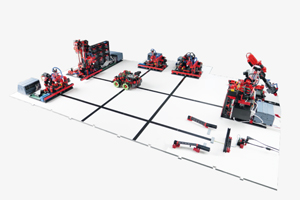 |
Training Factory Industry 4.0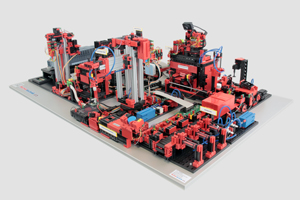 |
|---|---|---|
| Core Purpose | Teach agile production strategy | Simulate a full Industry 4.0 infrastructure |
| Production Structure | Modular & reconfigurable | Networked smart factory |
| PLC Depth | Introductory to advanced | Advanced industrial PLC integration |
| IoT & Cloud | Integrated | Deep, industrial-grade integration |
| Research Compatibility | Supports hands-on learning and applied experiments | Can be used with external AI or research systems and advanced integration projects |
| Best Fit | Agile production training, digital twin exercises | Industrial automation training, applied research, system integration |
| Ideal Audience | Industry training, higher education, and applied learning environments | Higher education, industrial automation programs, and applied integration environments |
Frequently Asked Questions
What is the difference between Agile Production Simulation and Training Factory 4.0?
APS focuses on agile production philosophy and modular flexibility. Training Factory 4.0 simulates a fully networked Industry 4.0 production environment with advanced PLC and IoT integration.
Are these systems suitable for higher education?
Yes. These simulation models are widely used in universities for undergraduate and postgraduate engineering programs, particularly in automation, mechatronics, production engineering, and Industry 4.0 research.
Can these models support artificial intelligence research?
Researchers have used the Training Factory 4.0 in studies involving neural network production control and distributed AI. APS provides a platform for AI-driven quality control and digital twin experimentation in hands-on learning or research settings.
Do they require industrial PLC knowledge?
The systems support structured text programming, PLC integration, and Python-based control options, making them suitable for both introductory and advanced levels.
Are they scalable for industry training?
Yes. Both simulations are used for in-company and inter-company training, including industrial automation training, enabling workforce upskilling in digital production technologies.
Conclusion
fischertechnik simulation models help higher education and industry institutions bring the future of production into the classroom and lab. The Agile Production Simulation enables hands-on learning in agile manufacturing, digital twins, and AI-supported quality control. At the same time, the Training Factory 4.0 delivers advanced PLC programming, IoT integration, and fully networked Industry 4.0 simulations. Together, these models bridge theory and practice, preparing students and professionals for real-world digital manufacturing challenges in a networked smart factory environment that is safe, scalable, and immersive.
Share this Post