
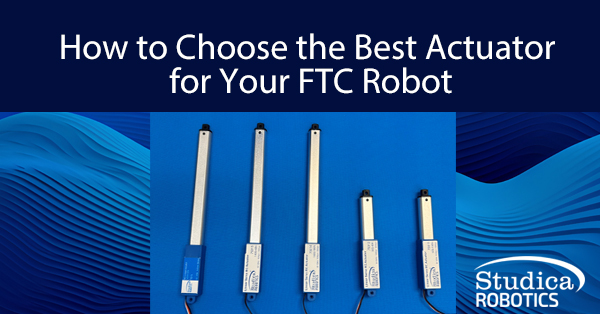
In the fast-paced world of FTC robotics competitions, every component matters. Selecting the right actuator can make the difference between smooth, efficient performance and costly breakdowns during a match. Linear actuators offer mechanical advantages that can be used in different robotics applications, especially when precision and controlled movements are key. In this guide, we’ll explore the purpose of these important, compact, and simple linear motion tools and how to select the best linear servo RC actuator to boost your FTC robot’s performance. Whether you need power for heavy lifting or speed for quick extensions, the right actuator can make all the difference.
How to Choose an Actuator
Imagine your robot extending its arm with lightning speed or smoothly lifting heavy objects easily—that’s the power of selecting the correct linear actuator. An actuator converts electrical signals into motion. While standard servos control angular movement, linear actuators move in a straight line, making them ideal for precision tasks—such as lifting, extending, or pushing parts of your robot. Here are key factors to consider:
Max Force and Speed:
Force is measured in newtons (N), and speed is the rate at which the actuator extends. Choose according to your needs:
- 190N (Approx. 43 lbs):
Built for high load capacity, operating at 6 mm/s. Perfect for heavy-duty tasks like suspending or lifting robots. - 95N (Approx. 21 lbs):
Offer a balance of power and speed, extending 13 mm/s. Ideal for tasks requiring strength without compromising speed. - 40N (Approx. 9 lbs):
Designed for lighter tasks, with fast movement at 24 mm/s. Great for applications needing quick extension with minimal force.
Stroke Length:
-
- 50mm Stroke: Ideal for compact builds or tasks where reach isn’t crucial.
- 140mm Stroke: Suited for tasks requiring greater reach, like extending arms or hanging mechanisms.
Linear Servo Actuator Comparison
Here’s a breakdown of Studica Robotics’ linear servo RC actuators:

-
- 140S-190N Actuator: With a 140mm stroke and 13 mm/s speed, this actuator provides 190N of force. It’s ideal for mechanisms that need both power and speed, such as extending arms or secondary slides in a multistage elevator. It’s powerful enough to suspend a robot on its own.
- 140S-95N Actuator: This 140mm stroke actuator balances power and speed, with a 13 mm/s speed and 95N force. It’s perfect for lifting and pushing tasks where stability is key. It’s slower than the 40N actuator but excels at handling heavier loads. Note: This option is only available while supplies last.
- 140S-40N Actuator: Featuring a 140mm stroke and fast 26 mm/s speed, this actuator offers 40N of force, making it ideal for fast extensions over long distances, such as in hanging mechanisms.
- 50S-190N Actuator: This 50mm stroke actuator operates at 6 mm/s and delivers 190N of force, making it suitable for short-distance tasks requiring high load capacity, like cascading slides.
- 50S-40N Actuator: Compact with a 50mm stroke and 26 mm/s speed, this actuator delivers 40N of force and is perfect for precision tasks like small arms or grippers, as well as pick-and-place mechanisms.
View details for these robot actuators in the table below! ⇓
|
Control Signal |
|
PWM (Pulse Width Modulation) |
|||||
|
Frequency |
50 Hz |
||||||
|
Voltage (VDC) |
6VDC |
||||||
|
Linear Servo RC Actuator |
|||||||
|
Part # |
|||||||
|
Stroke Length (mm) |
50mm |
140mm |
|||||
|
Gear Ratio |
150:1 |
36:1 |
63:1 |
150:1 |
36:1 |
||
|
No Load |
Speed (mm/s) |
6 |
24 |
13 |
6 |
24 |
|
|
Current (mA) |
150 |
150 |
150 |
150 |
150 |
||
|
Max Efficiency Point |
Load (N) |
75 |
16 |
30 |
75 |
16 |
|
|
Speed (mm/s) |
5 |
20 |
11 |
5 |
20 |
||
|
Current (mA) |
360 |
360 |
360 |
360 |
360 |
||
|
Peak Power Point |
Load (N) |
170 |
30 |
66 |
170 |
30 |
|
|
Speed (mm/s) |
3.3 |
17 |
8 |
3.3 |
17 |
||
|
Current (mA) |
560 |
560 |
560 |
560 |
560 |
||
|
Max Force |
Load (N) |
190 |
40 |
95 |
190 |
40 |
|
|
Speed (mm/s) |
2.5 |
14 |
5 |
2.5 |
14 |
||
|
Current (mA) |
820 |
620 |
850 |
820 |
620 |
||
|
Stall Torque (N) |
325 |
50 |
150 |
325 |
50 |
||
|
Stall Current (A) |
1 |
1 |
1 |
1 |
1 |
||
|
Max Static Force (N) |
190 |
40 |
100 |
190 |
40 |
||
|
Weight (g) |
65 |
65 |
96 |
96 |
96 |
||
|
Stroke Repeatability (mm) |
±0.5 |
||||||
|
Max Side Load (N) |
10 |
||||||
|
Operating Temperature Range (˚C) |
-10 ~+50 |
||||||
|
Storage Temperature Range (˚C) |
-10 ~+50 |
||||||
|
Wire Length (mm) |
340 |
||||||
|
Connector |
2.54mm Dupont 3-Pin Female |
||||||
*Available while supplies last!
Understanding Pulse Range Width
Linear servos have a different pulse width range compared to standard servos. While regular servos operate within a 500-2500 µs range, linear servos typically work within 900-2100 µs. Calibration is often needed, as each servo may have slightly different values for the fully retracted and extended positions. This is crucial for programming, especially when using Java.
Maximize Your Robot’s Potential
Now that you know how to choose the best linear servo actuator, it’s time to put that power into action. Make sure your robot has the best chance to outperform the competition, equip it with the optimal linear servo actuator from Studica Robotics today!
Share this Post